
Pacific Group AI Takes the Commonwealth Stage and makes its mark
Media Release — 25 March 2026
Cook Islands-founded agency addresses Commonwealth ministers and regional leaders on AI workforce transformation at historic inaugural roadshow in Vanuatu
PORT VILA, VANUATU — Pacific Group AI, the Cook Islands-founded AI transformation agency, made its international debut at the Commonwealth Digital Roadshow in Vanuatu on 23 March 2026 — delivering what attendees and organisers described as one of the standout presentations of the day.
Founder and Director Tayla Jayne Beddoes was invited by the Commonwealth Telecommunications Organisation (CTO) to speak in Session 4: Artificial Intelligence — Opportunities, Risks and Practical Paths for Vanuatu, addressing the topic "Preparing the Workforce for an AI-Enabled Future."
The Commonwealth Digital Roadshow is the CTO's flagship initiative marking its 125th anniversary of service to the Commonwealth. Vanuatu was selected as the first destination, with Day 1 bringing together government ministers, senior officials, ICT regulators, private sector leaders, and regional decision-makers from across the Pacific and beyond.
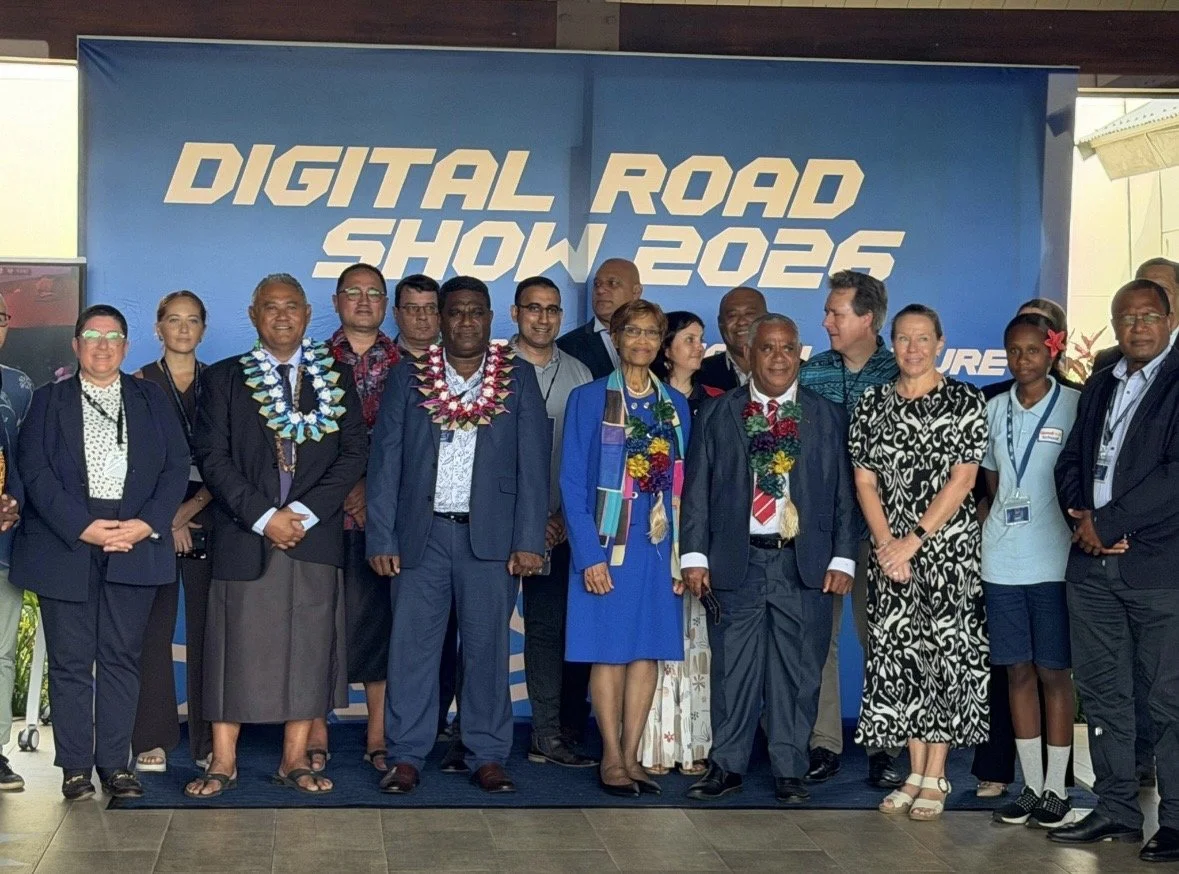
Tayla Jayne Beddoes (Pacific Group AI) alongside the Honourable Jotham Napat, Prime Minister of Vanuatu, Ms Bernedette Lewis, Secretary General of the Commonwealth Telecommunications Organisation, government ministers, regional leaders, Her Excellency Nicolette Brent MBE, British High Commissioner to Vanuatu, and fellow speakers and experts at the Commonwealth Digital Roadshow — Vanuatu, 23 March 2026.
A Pacific Perspective on a Global Conversation
In a session that also featured speakers from global firms including AI Asia Pacific Institute, Beddoes took a deliberately different approach — grounding her address not in theory or policy frameworks, but in the on-the-ground realities of AI adoption across Pacific organisations.
Drawing on real case studies from the Cook Islands, Vanuatu and Fiji, she made the case that the most significant barrier to AI transformation in the region is not technology access — it is workforce preparation.
"In a survey of 2000 companies across 105 countries, 88% of organisations are reportedly using AI in at least one area of their business," she told the room, “but only 6% are achieving meaningful results. The differentiator, according to McKinsey's own research, is whether organisations prepared their people before they deployed the tools. That gap is what we exist to close."
The address drew on data from Anthropic's March 2026 labour market report, the World Economic Forum's Future of Jobs Report 2025, and McKinsey's State of AI 2025 — alongside Pacific-specific case studies that illustrated the gap between global AI capability and observed regional usage.
Feedback from organisers and attendees following the session positioned the presentation as one of the best of the day — noted specifically for its ability to translate complex concepts into practical, Pacific-relevant insight.
"The theory always applies," Beddoes reflected after the event. "But it doesn't fully correlate to our part of the world. What people responded to was seeing it brought back down to a real perspective — what does this actually look like in practice, right here, right now."
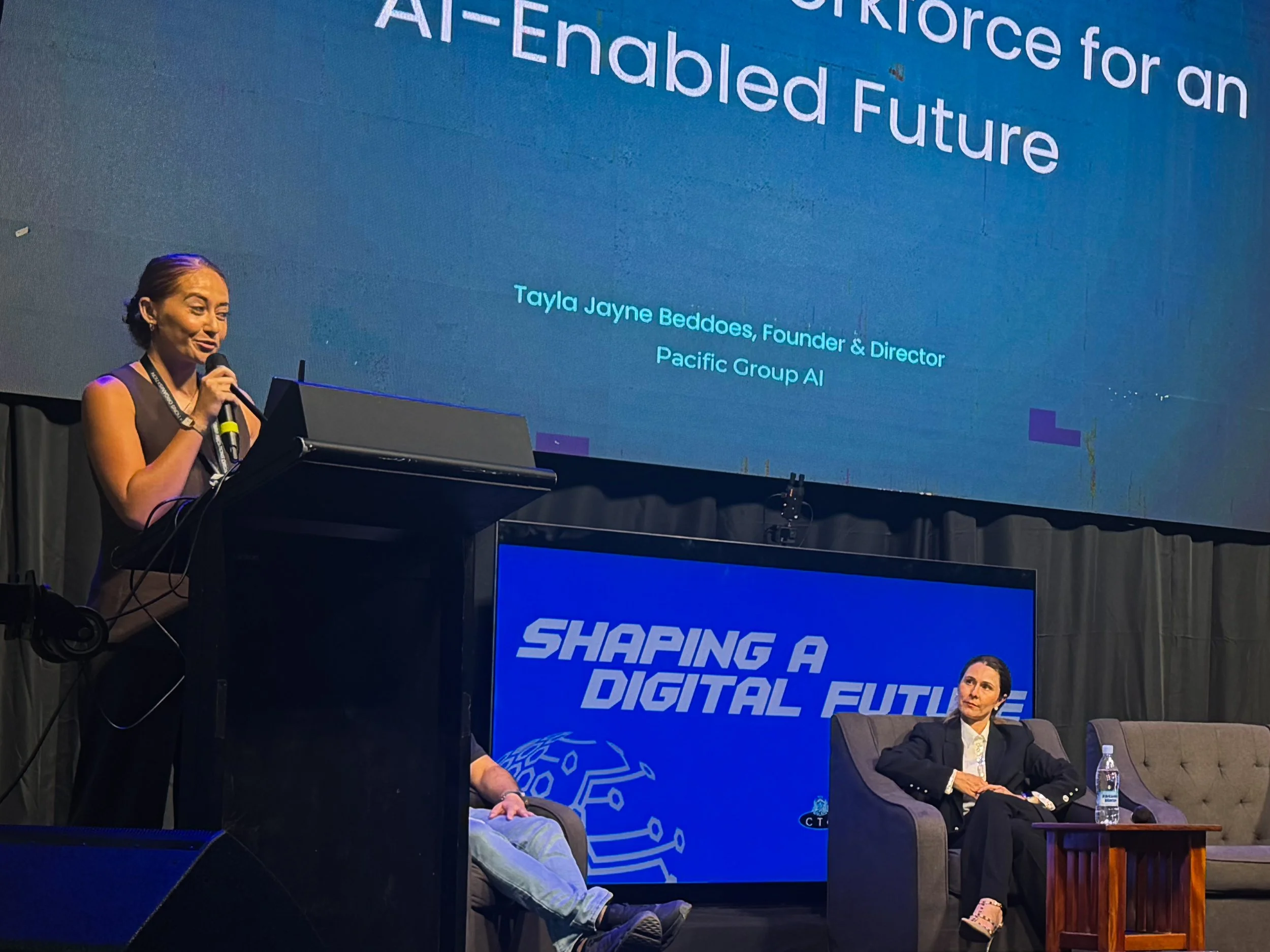
Tayla Jayne Beddoes (Pacific Group AI) addresses Commonwealth ministers, senior officials and regional leaders during Session 4: Artificial Intelligence — Opportunities, Risks and Practical Paths for Vanuatu
Innovation Built from the Inside Out
Pacific Group AI was founded in early 2025 with a mission to blend ancestral intelligence with artificial intelligence — modernising Pacific organisations in a way that works for Pacific people, without overwriting the identity, culture and context that make the region unique.
What sets the agency apart is not just what it does, but how.
Where most technology providers offer tools, platforms or one-size-fits-all programmes, Pacific Group AI operates as a transformation partner — embedding directly into the organisations it works with, conducting operational audits, building tailored solutions, and training internal teams to own and sustain the technology long after the engagement ends.
It is a model that took time to develop. Early in the agency's formation, it became clear that approaches designed for Western markets — with their different infrastructure, resources, constraints and cultural contexts — could not simply be transplanted into the Pacific and expected to work.
"The hardest thing has been the approach," Beddoes explained. "Coming into this space and realising that what works for the rest of the world isn't automatically going to work here. We have different infrastructure, different resources, different constraints, different context. Building a model that actually accounts for that — that starts Pacific and works outward — that's been the work."
The model Pacific Group AI has developed operates across three interconnected layers:
First — building capability from within. Workforce training that gives teams the skills to help themselves, ensuring people are not left behind as technology evolves. Capacity built in-house means organisations are not perpetually dependent on external support.
Second — strategic roadmapping. Because training alone is not enough. Every organisation needs a clear picture of where AI can genuinely move the needle for them specifically — not a generic checklist, but a custom blueprint built around their actual workflows, their actual constraints, and their actual goals. This is what the agency's AI audit process delivers.
Third — building the right solutions. With a clear roadmap in place, Pacific Group AI develops and deploys the solutions that match. Not solutions imported from elsewhere and retrofitted, but solutions designed for the Pacific context from the ground up.
It is an approach that, to date, has no direct equivalent anywhere in the region.
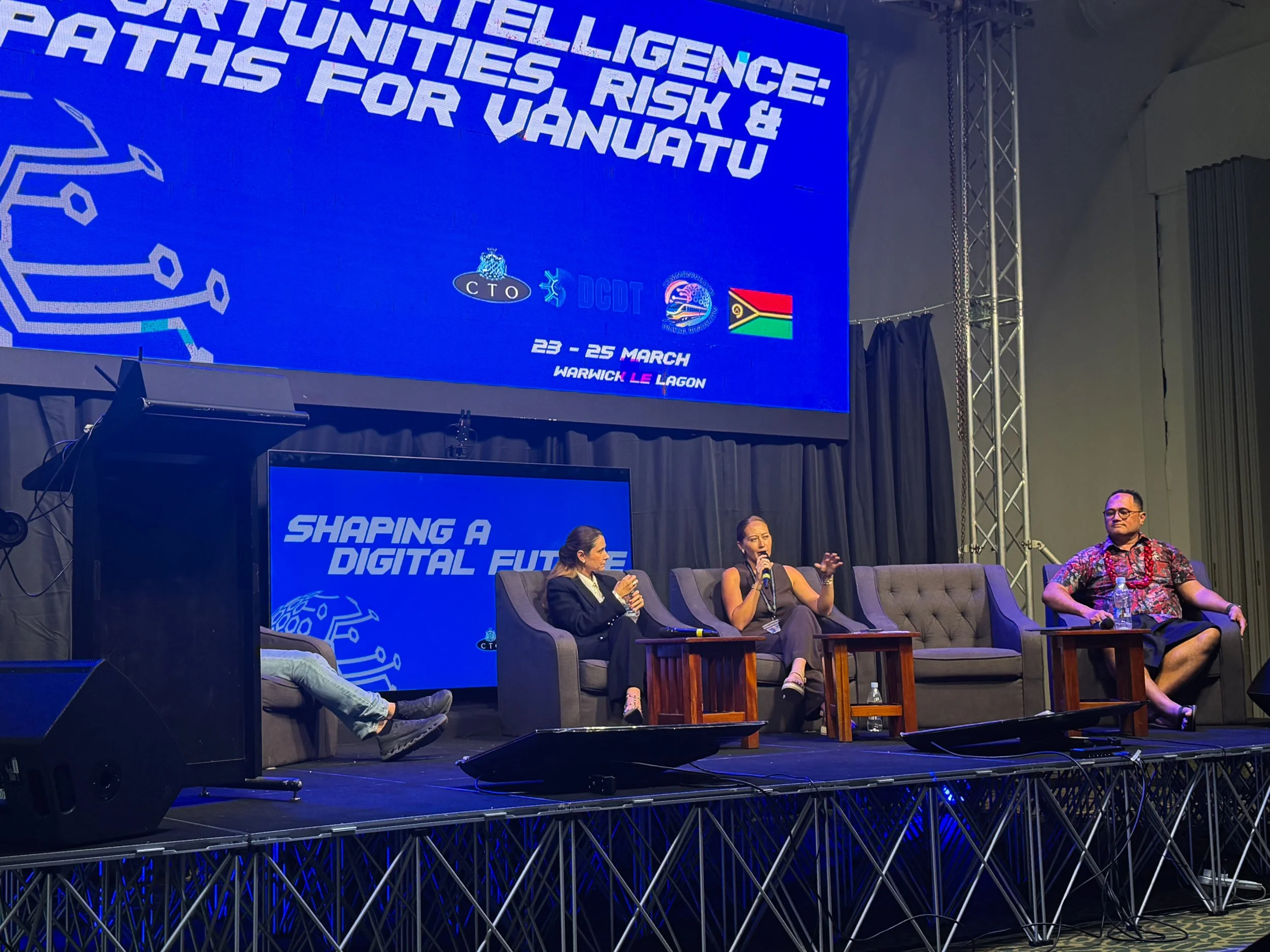
Kelly Forbes (Executive Director, AI Asia Pacific Institute), Tayla Jayne Beddoes (Pacific Group AI) and a representative from Samoa address questions from the audience during the AI session.
A Region Ready to Move
The Commonwealth Digital Roadshow appearance comes at a pivotal moment for Pacific Group AI. Since launching its national AI upskilling programme in the Cook Islands in October 2025, the agency has trained over 200 working professionals — approximately 2.5% of the nation's workforce — with hundreds more confirmed across coming months.
Operations have since expanded into Vanuatu and Fiji, where the agency has delivered training, conducted audits and built custom AI solutions for businesses and government organisations.
The appetite, Beddoes noted, is real — and growing.
Following her address at the Roadshow, she fielded conversations with senior regional stakeholders, with early discussions already underway around further speaking engagements in Vanuatu and deeper regional partnerships. The response, she observed, reflects something broader than professional interest.
"There's a very real appetite for this — and it's not about blindly adopting technology. It's about having a specific person leading the charge who genuinely wants to see it work in the best way possible for our region. Without replacing identity. Without replacing physical jobs. I think that's starting to come through, and there's real trust being placed in that."
Papua New Guinea's recent milestone — becoming the first Pacific island nation to deploy generative AI in a government production environment, through a locally-built solution by Port Moresby-based company NiuPay — signals that the region is already moving. Pacific Group AI's invitation to speak at the Commonwealth's inaugural Digital Roadshow is further evidence that the Pacific is not waiting to be included in the global AI conversation. It is stepping into it, on its own terms.
About Pacific Group AI
Pacific Group AI is the Cook Islands' first and only AI transformation agency, and the only agency of its kind operating across the Pacific. Cook Islands-based and Pacific-served, the agency works alongside governments, businesses and organisations across the region — auditing operations, building tailored AI solutions, and training internal teams to own and sustain the technology long after the work is done. The agency is built on a mission to blend ancestral intelligence with artificial intelligence, and to ensure AI modernises Pacific organisations on Pacific terms.
